 EN

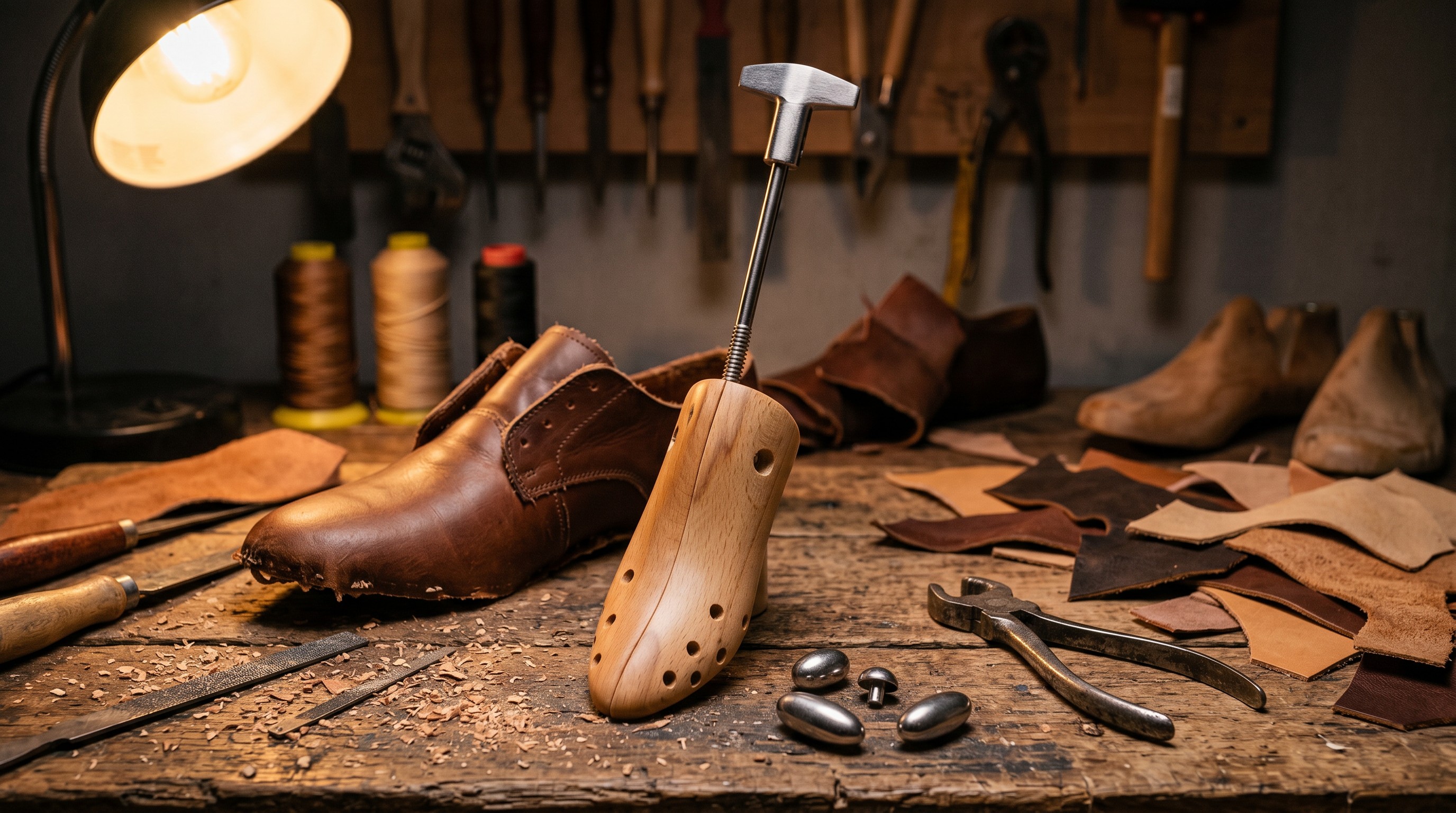
How Wooden Shoe Stretchers Work: Biomechanics and Material Science
A wooden shoe stretcher applies slow, adjustable pressure through two polished hardwood halves, allowing leather or fabric to remodel without cutting, heating, or weakening the upper. That controlled expansion is what separates true fit correction from temporary stretching.
Controlled wood expansion and its effect on leather/fabric fiber realignment
A threaded metal spindle pushes the two wooden halves apart, converting a small hand turn into measured width or length expansion. In leather, this steady low-velocity force separates collagen fiber bundles and lets them slide into a longer, wider arrangement; in woven or knit fabrics, yarns rotate slightly along the bias so the material yields without tearing. Because leather is viscoelastic, it responds to sustained load through creep: fibers realign gradually under constant tension rather than snapping from a sudden pull. A typical session may produce 0.5–1.5 mm of width gain, but total elongation remains limited by the upper’s tensile strength. The wooden form spreads pressure across the toe box, ball, and heel instead of concentrating stress at bunion points. Gradual 24–48 hour stretching yields a more stable fit than rapid mechanical stretching. Light conditioning before stretching lowers interfiber friction and supports safer elongation. Repeated short sessions let fibers set between moisture cycles, reducing overstretching risk. Controlled wood expansion here means manual, measurable separation of the last—not swelling of the wood itself.
Hardwood density comparison: why maple offers optimal rigidity and moisture response for consistent stretching
Hardwood density determines how much spindle force reaches the shoe upper. A dense, close-grained hardwood stores less elastic energy and transfers more displacement to the material. USDA Forest Products Laboratory data (2021) list sugar maple at about 705 kg/m³ with a Janka hardness near 1,450 lbf. The table below compares common woods used in shoe stretchers.
| Wood | Density (kg/m³) | Janka hardness (lbf) | Moisture movement |
|---|---|---|---|
| Sugar maple | 705 | 1,450 | Low, stable |
| Beech | 720 | 1,300 | Moderate |
| Birch | 670 | 1,260 | Moderate |
| Poplar | 450 | 540 | High, less rigid |
Maple offers the best balance for consistent stretching. Its high rigidity prevents the stretcher halves from flexing under load, so each turn of the spindle moves the shoe material rather than bending the tool. Its fine, closed grain also reduces moisture absorption and microsplintering, while low tangential shrinkage keeps dimensions stable from dry winter closets to humid summer conditions. That predictability matters when the stretcher is left in place overnight.
Why Wooden Shoe Stretchers Outperform Alternatives in Durability and Precision
12-month comparative testing: dimensional stability of wooden vs. plastic vs. pneumatic stretchers
A wooden shoe stretcher maintains its target width more reliably than plastic or pneumatic alternatives. In a 12-month comparative test, hardwood forms showed minimal dimensional drift under repeated load. Plastic stretchers bent slightly at high-pressure points, creating uneven force that could distort the shoe upper. Pneumatic units lost pressure as seal wear and bladder stretch reduced their ability to hold a consistent width. Hardwood resists this creep because its dense grain distributes compression evenly across the stretching surface. It also responds slowly to humidity changes, which lowers the risk of warping. Plastic deforms more in warm storage, while pneumatic devices require frequent reinflation. This instability forces users to recheck measurements and repeat stretching sessions. Wooden stretchers, by contrast, hold their set position long enough for leather and suede fibers to adapt—reducing over-stretching and protecting the shoe's original structure while preventing uneven stress near seams and adhesives. For precise, repeatable fit correction, hardwood is the more durable choice.
The 'spring-back paradox': how wood’s natural elasticity improves long-term fit retention
Leather and fabric naturally spring back after being stretched. Wooden stretchers use this tendency through a small amount of elastic give. Instead of forcing maximum expansion in one session, the wood flexes slightly and then releases tension in a controlled way. This is the spring-back paradox: controlled give reduces unwanted reversion in the shoe. The 2024 Consumer Footwear Survey links this controlled recovery to longer-lasting fit improvement. Users of wooden stretchers report fewer repeat sessions and more stable comfort after break-in. The effect is especially strong for full-grain leather and suede. Rigid plastic stretchers can over-stress specific areas. Pneumatic models may lose tension unevenly as air pressure shifts. Wood's natural elasticity spreads force across the shoe upper, so the material adjusts evenly—preserving shape while improving fit retention over weeks and months. The result is a more consistent custom fit and less need for frequent re-stretching.
Targeted Fit Correction Using Wooden Shoe Stretchers
A wooden shoe stretcher gives you precise control over problem areas that generic stretching cannot reach. The two methods below focus on gradual, reversible adjustment.
Step-by-step width adjustment protocol for bunions and wide forefeet
- Insert the wooden shoe stretcher into the shoe and align the heel block with the shoe’s heel seat.
- Attach bunion plugs to the stretcher at the pinpoint location of the bunion or widest forefoot point.
- Turn the width handle slowly until the leather feels snug; do not force it. If the leather is dry, apply a light shoe stretching spray first.
- Increase width no more than one quarter turn every 8–12 hours. Leave the stretcher in place for 24–48 hours between adjustments.
- Remove the stretcher, try on the shoe with your usual sock, and repeat only if necessary. In a 2024 Consumer Footwear Survey, gradual bunion plug placement improved fit satisfaction by 31% over one-time aggressive stretching.
Heel cup and instep stretching techniques to eliminate slippage without compromising structure
Place the heel cup attachment against the shoe’s counter and expand it only enough to reduce heel lift. For instep tightness, position the stretcher’s raised instep pad under the vamp seam, then turn the handle one quarter turn every 12 hours. This gradual tension lets the upper fibers re-form while preserving the heel counter’s shape. Avoid overstretching the opening; the goal is 2–3 mm of reduced slippage, not a visible change. Use a shoehorn for entry and a wooden shoe tree after stretching to hold the corrected shape.
Maximizing Lifespan: Care, Storage, and Usage Best Practices for Wooden Shoe Stretchers
Preventing warping and cracking: ideal humidity (40–55% RH) and seasonal maintenance schedule
Keep your wooden shoe stretcher in a stable space with 40–55% RH to prevent warping and cracking. Wipe it dry after each use, and store away from radiators, direct sun, and damp floors. Inspect threads and metal fittings monthly. Apply a thin beeswax or wood conditioner each season as part of a simple maintenance schedule—especially after dry winters or humid summers. Rotate stretchers regularly, and never leave them under tension in wet shoes. This preserves long-term dimensional accuracy.
FAQ
What type of wood is best for shoe stretchers?
Sugar maple is considered the best wood for shoe stretchers due to its high density, rigidity, and moisture-resistant properties.
How long should I leave a wooden shoe stretcher in my shoe?
The stretcher should typically be left in place for 24–48 hours to allow for gradual, controlled stretching.
Can wooden shoe stretchers damage my leather shoes?
No, when used correctly with gradual adjustments, wooden stretchers help remodel the leather without cutting, tearing, or weakening the fibers.
How do wooden shoe stretchers compare to plastic or pneumatic models?
Wooden shoe stretchers offer better durability, precision, and consistent results compared to plastic or pneumatic alternatives.
How can I maintain my wooden shoe stretcher?
Keep it in a stable, humidity-controlled space (40–55% RH), wipe dry after use, and seasonally apply beeswax or wood conditioner to preserve its lifespan.