 EN

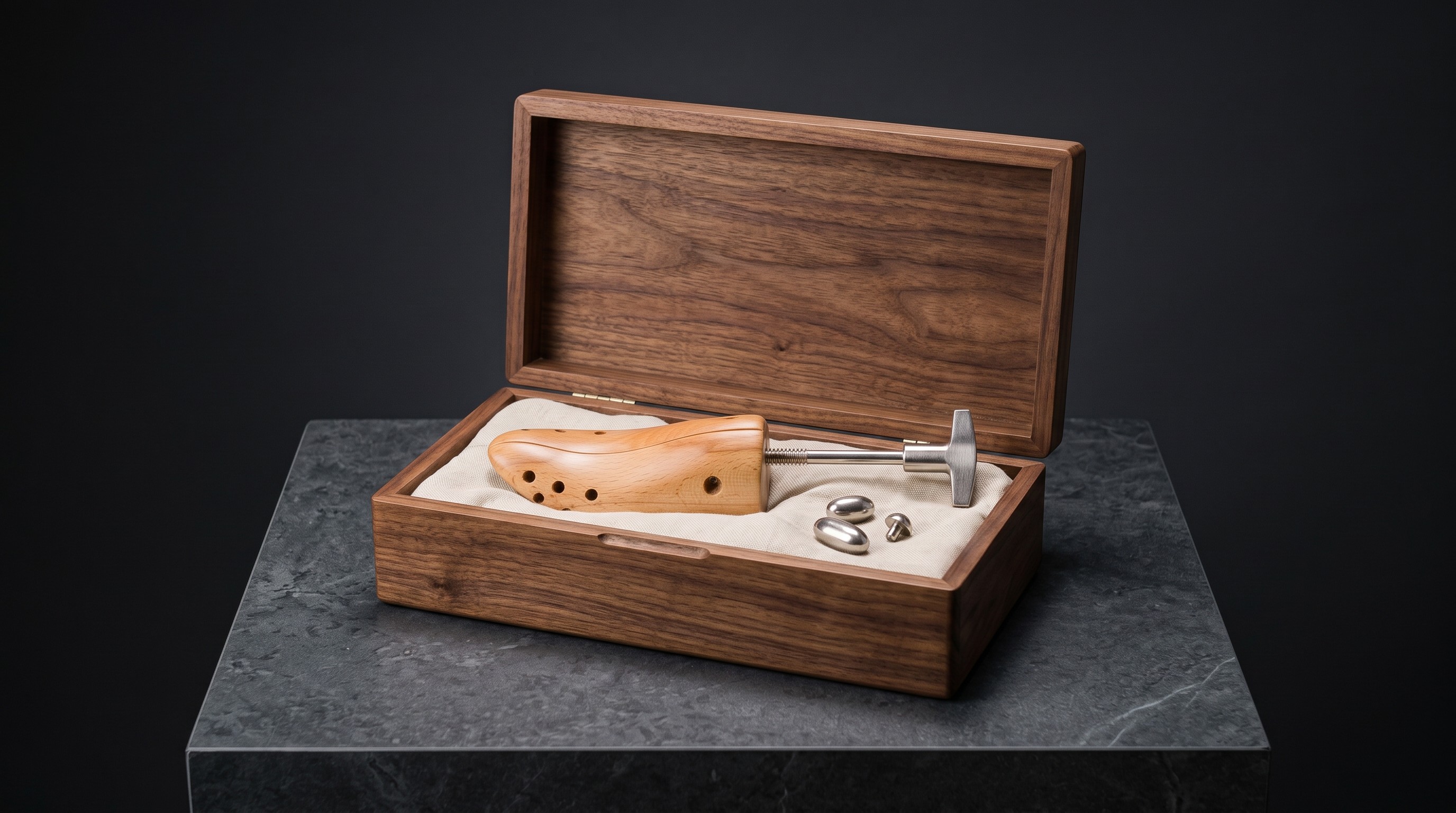
Why Premium Shoe Care Brands Rely on Wooden Shoe Stretchers
Biomechanical stability: How beechwood and maple preserve last integrity during stretching
High-end shoe care brands consistently choose wooden shoe stretchers because of the biomechanical stability that hardwoods like beechwood and maple provide. Unlike plastic alternatives—which can creep under sustained tension—these dense woods maintain dimensional integrity over time. Beechwood, with a density of ~720 kg/m³, delivers exceptional rigidity that resists bending during high-tension stretching of structured uppers. Maple adds balanced hardness and subtle shock absorption, enhancing resilience without compromising shape fidelity. Both species feature straight, fine grain that distributes mechanical force uniformly across the shoe’s interior—preventing localized pressure points that distort the original last, the foundational shape defining fit and aesthetics. Plastic stretchers often develop micro-warping after repeated use, leading to inconsistent expansion and unintended stress on seams or linings. Hardwood, by contrast, sustains a stable contact surface, protecting leather’s cellular structure and minimizing fiber degradation from micro-splintering—a risk more common in softwoods. By preserving last integrity, wooden stretchers extend the life of premium footwear and ensure each stretch remains faithful to the designer’s intent.
Proven performance: 92% lower deformation vs. plastic stretchers (2023 Footwear Materials Benchmark)
Quantitative testing confirms wood’s structural superiority. The 2023 Footwear Materials Benchmark found wooden shoe stretchers exhibited 92% less permanent deformation than plastic equivalents after 500 stretch cycles. This means wooden tools retain their precise geometry far longer, delivering consistent, repeatable results across hundreds of uses. Plastic models gradually lose shape, increasing the risk of uneven width expansion, distorted toe boxes, or internal lining damage. For luxury brands—where millimeter-level fit precision is non-negotiable—such variability threatens service reliability, customer satisfaction, and return rates. Wood’s superior creep resistance and stiffness translate directly into operational dependability for professional shoe care providers. The benchmark reinforces why industry leaders rely on hardwood stretchers: they deliver predictable, high-fidelity stretching aligned with the exacting standards of premium footwear.
Critical Design and Material Specifications for Professional Wooden Shoe Stretchers
Wood grain orientation and moisture content (<8% MC) for warp resistance
A high-performance wooden shoe stretcher depends on precise wood grain alignment and strict moisture control. Quarter-sawn or rift-sawn blanks—with growth rings oriented nearly perpendicular to the working face—deliver superior dimensional stability by limiting tangential expansion, the primary cause of twisting under load. Moisture content must be reduced to below 8% through controlled kiln drying. At this level, free water is fully removed from wood cell walls, minimizing hygroscopic movement in fluctuating humidity. A leading manufacturer reports that beechwood stretchers dried to 6–7% MC show less than 0.1% dimensional change across 30 simulated-use cycles, while improperly dried samples warp visibly after just five. Consistent low moisture content also inhibits mold growth and preserves the smooth surface essential for protecting premium leather linings. For brands sourcing durable wooden shoe stretchers, specifying ≤8% MC in procurement documents is a non-negotiable quality gate.
Precision-machined joints (<0.15mm tolerance) ensuring uniform pressure distribution
The multi-part mechanism of a wooden shoe stretcher—center spindle, split block, and expansion wings—must transfer force evenly to avoid stress hotspots. Loose or uneven joints concentrate pressure on narrow areas, risking leather deformation or seam failure. Research published in Journal of Wood Engineering (Khan et al., 2025) confirms that joint tolerances below 0.15 mm are essential for uniform load distribution. In practice, CNC-machined components with a clearance fit of 0.10–0.15 mm allow smooth actuation while eliminating slack. When tightened, the expansion wings press evenly against the shoe’s interior, mirroring natural foot contours. This prevents overstretching at critical zones like the toe cap or heel counter—preserving structural integrity. Stringent quality control, including laser measurement of every assembled unit, ensures compliance with this sub-0.15mm standard, enabling gentle, repeatable broadening for high-value footwear lines.
Selecting the Right Wood Species by Footwear Type
Selecting the correct wood species for a wooden shoe stretcher is a strategic decision for professional shoe care brands—directly impacting service quality and material longevity. The physical properties of the wood must align with the structural demands of the specific footwear to ensure effective, damage-free stretching. Material mismatch remains a leading cause of ineffective stretching, resulting in leather deformation or incomplete expansion. The following table compares the two primary wood species recommended for professional applications.
| Wood Species | Optimal Density | Key Mechanical Property | Primary Application |
|---|---|---|---|
| Beechwood | 720 kg/m³ | High compressive strength | Structured dress shoes, high-tension stretching |
| Maple | 640–720 kg/m³ | Balanced hardness and shock absorption | Flexible loafers, moccasins, and soft leathers |
Beechwood for structured dress shoes: Optimal density (720 kg/m³) for high-tension stretching
Beechwood’s density of ~720 kg/m³ provides the compressive strength needed to reshape structured dress shoes—such as Oxfords and Derbies—without deforming under load. Its fine, tight grain withstands the high-tension stretching required for firm calfskin or cordovan leathers, maintaining precise geometry over thousands of cycles. Unlike softer woods, beechwood transmits force efficiently, allowing targeted correction of pressure points—like bunions or tight toe boxes—without cracking or creasing delicate uppers.
Maple for flexible loafers and moccasins: Balanced hardness and shock absorption
For flexible footwear like loafers and moccasins—constructed from pliable leathers—maple offers an ideal balance of structural integrity and gentle resilience. Its inherent shock absorption prevents over-stretching that could permanently distort an unstructured silhouette. The uniform, low-impact pressure from a maple stretcher works in harmony with the leather’s natural flex—critical for preserving hand-sewn uppers and retaining the soft, broken-in feel that defines such footwear. This nuanced responsiveness ensures a comfortable, customized fit without compromising design integrity.
B2B Compliance: Certifications and Traceability for Luxury Brand Partnerships
FSC®/PEFC™ chain-of-custody documentation as non-negotiable for premium brand procurement
FSC (Forest Stewardship Council) and PEFC (Programme for the Endorsement of Forest Certification) chain-of-custody documentation is a non-negotiable requirement for premium brand procurement of wooden shoe stretchers. This certification provides auditable proof that the wood originates from responsibly managed forests, meeting rigorous environmental and social standards. For luxury brands committed to sustainability pledges—and subject to evolving regulations like the EU Deforestation Regulation—traceability is essential to mitigate reputational and compliance risk. Without verified chain-of-custody records, suppliers are excluded from high-value partnerships. Regular third-party audits confirm supply chain integrity, ensuring every wooden shoe stretcher supports ethical sourcing commitments, strengthens consumer trust, and safeguards brand reputation.
FAQ
Why are wooden shoe stretchers preferred over plastic alternatives?
Wooden shoe stretchers are preferred because they maintain biomechanical stability over time, resist deformation, and distribute mechanical force more uniformly. This ensures better protection of premium leather and lasts integrity compared to plastic models.
What are the primary wood species used in shoe stretchers?
Beechwood and maple are the key hardwood species used in professional wooden shoe stretchers. Beechwood provides high compressive strength for structured shoes, while maple offers shock absorption for flexible footwear.
Why is moisture content critical in wooden shoe stretcher fabrication?
Moisture content below 8% ensures warp resistance, inhibits mold growth, and preserves dimensional stability, which are essential for durability and optimal performance in fluctuating humidity conditions.
How do FSC and PEFC certifications impact wooden shoe stretcher procurement?
These certifications ensure traceability and responsible wood sourcing, supporting luxury brands' sustainability goals and compliance with regulations, such as the EU Deforestation Regulation.
Can wooden shoe stretchers be used on all types of footwear?
Yes, but the choice of wood species varies by type. Beechwood is suitable for structured dress shoes, while maple is ideal for flexible loafers, moccasins, and soft leather styles.
Table of Contents
- Why Premium Shoe Care Brands Rely on Wooden Shoe Stretchers
- Critical Design and Material Specifications for Professional Wooden Shoe Stretchers
- Selecting the Right Wood Species by Footwear Type
- B2B Compliance: Certifications and Traceability for Luxury Brand Partnerships
-
FAQ
- Why are wooden shoe stretchers preferred over plastic alternatives?
- What are the primary wood species used in shoe stretchers?
- Why is moisture content critical in wooden shoe stretcher fabrication?
- How do FSC and PEFC certifications impact wooden shoe stretcher procurement?
- Can wooden shoe stretchers be used on all types of footwear?